
Why Cloud Costs Grow Faster Than Your Product


Cloud costs can grow faster than product usage when an application becomes less efficient as it scales. More customers, transactions, and data naturally increase infrastructure usage, but they do not always explain how quickly cloud spending increases.
Cloud infrastructure is supposed to make growth easier. As your customer base increases, your application can use more compute, storage, databases, and network capacity without requiring you to purchase and maintain physical infrastructure.
But there is a point where cloud growth can become difficult to explain.
Your users may be increasing steadily while your infrastructure costs are increasing much faster. A 20% increase in usage can sometimes produce a much larger increase in cloud spending. When that happens, the problem is not necessarily the cloud provider or the price of an individual service.
Often, the problem is how the application is using the infrastructure.
Cloud costs should increase as your product grows. But when costs consistently grow faster than the product itself, it is worth investigating what is happening inside the architecture.
Key Takeaways
Cloud spending does not always scale proportionally with users, revenue, or transactions.
Significant cost increases can be driven by application behavior, not simply by the price of individual cloud services.
Database queries, data transfer, logging, autoscaling, and resource allocation can create costs that are difficult to understand from the application layer alone.
Budgets and alerts can help detect unusual spending, but they do not replace root-cause analysis.
Cost optimization is most effective when engineering teams connect infrastructure usage with application behavior.
As a product scales, architecture decisions that were reasonable early on can become expensive or inefficient.
Sustainable cloud cost management requires ongoing architectural review, not a one-time cleanup.
Product Growth Does Not Automatically Explain Cloud Cost Growth
It is reasonable to expect infrastructure costs to increase when a product becomes more successful.
More customers usually mean more requests. More requests may require more compute. More activity creates more data, and more data can increase storage and database usage.
That relationship is real, but it is not necessarily linear.
Consider a SaaS application that doubles its customer base. The increase in infrastructure usage may seem predictable at first. But if each customer action now triggers more database queries, additional service calls, larger data transfers, or more background processing, the infrastructure may be doing significantly more work for each transaction.
The product has doubled in size, but the workload generated by each interaction has also changed.
This is where cloud cost growth can begin to separate from product growth.
The architecture determines how efficiently an application turns additional usage into additional infrastructure work.
This is why cloud cost optimization should not be treated only as a finance or procurement exercise. AWS includes resource selection, capacity, data transfer, demand management, and ongoing workload reviews within its cost optimization guidance. Google Cloud similarly treats cost optimization as part of its broader approach to designing and operating cloud workloads.
The goal is not to prevent infrastructure costs from increasing as the product grows. The goal is to understand whether the additional spending is being driven by valuable product growth or unnecessary infrastructure work.
A growing product does not automatically have a cost problem.
An inefficiently growing architecture can.
Where Cloud Cost Growth Actually Comes From
Cloud bills are the final result of many technical decisions.
An application does not simply “use AWS” or “use Google Cloud.” It creates workloads. Those workloads consume resources according to how the software is designed, configured, and operated.
Consider a simple request.
A customer opens a feature in your application. That request may trigger an API call, access a database, retrieve objects from storage, call another internal service, write logs, send an event, and possibly invoke additional background processing.
One user action can therefore create many infrastructure operations.
At small scale, the difference may be insignificant.
At large scale, the difference can become substantial.
This is one reason cloud cost problems are often difficult to diagnose. The billing system shows where money was spent, but the underlying reason may exist somewhere else in the application.
A database may appear expensive because it is processing inefficient queries.
A compute service may appear expensive because an application is generating unnecessary work.
Network charges may increase because services are communicating in ways that were never significant during the early stages of the product.
Observability costs may grow because the application is producing far more logs or metrics than the team actually needs.
A useful way to approach these situations is to connect the visible cost increase with the technical behavior behind it:
What you observe | What may be happening | What to investigate |
Database costs increase faster than users | Queries are processing more data or running more often | Query patterns, indexes, scans, and data growth |
Compute usage increases unexpectedly | The application is generating more work per request | Application workloads, background jobs, and scaling signals |
Network costs rise | Services are transferring more data or communicating more often | Data transfer paths, payload sizes, and service-to-service calls |
Logging costs grow rapidly | The application is producing more logs or retaining them longer | Log volume, retention periods, and log levels |
Costs remain high after traffic drops | Resources may not be scaling down as expected | Minimum capacity, scaling policies, and idle resources |
The important question therefore becomes:
What is causing this resource to be used at this level?
That question is usually more valuable than simply asking:
Which service costs the most?
The Architecture Decisions That Become Expensive at Scale
Most cloud architectures are not designed perfectly from day one.
Early-stage teams have different priorities. They need to validate a product, release features, respond to customers, and reach the market. Optimizing every infrastructure decision before the product has proven demand can be a poor use of engineering time.
AWS explicitly recognizes this trade-off: cost optimization has to be balanced against factors such as speed to market and business requirements.
The problem begins when temporary decisions become permanent architecture.
A database configuration chosen for an early customer base may remain unchanged while the amount of data grows dramatically. A service may be given more capacity than it currently needs because the team wants to avoid performance problems. That may make sense initially, but the same configuration can become expensive when multiplied across multiple environments.
A logging strategy created to make debugging easier can eventually generate large volumes of data. A collection of services may communicate efficiently at low traffic levels but create significant network activity as usage increases.
The cost is often not created by the original decision itself, but by continuing to use that decision after the conditions have changed.
None of these decisions necessarily represent bad engineering.
They become problems when the system grows and the original assumptions are no longer true.
That is why cloud architecture needs to evolve with the product.
Why Databases and Data Workloads Deserve Special Attention
Data is one of the areas where cost behavior can change dramatically as a product grows.
A query that works perfectly well against a small dataset may become inefficient when the underlying data grows by an order of magnitude.
The same applies to analytics workloads.
If applications or reporting systems repeatedly process large amounts of data when only a small portion is actually needed, the cost can increase much faster than the number of users.
The solution is not always to buy more database capacity.
Sometimes the better solution is to change how the application accesses the data.
That can involve improving indexes, changing queries, partitioning data, reducing unnecessary scans, redesigning data access patterns, or changing how analytical workloads are separated from transactional workloads.
The broader principle is important:
Infrastructure optimization often begins with application optimization.
If the software continuously creates inefficient workloads, increasing infrastructure capacity may improve performance while simultaneously increasing the bill.
Scaling Can Increase Costs Even When Traffic Is Unpredictable
Autoscaling is one of the major advantages of cloud infrastructure. Resources can increase when demand rises and decrease when demand falls.
But autoscaling does not automatically make an application cost-efficient.
Scaling policies depend on the signals they receive.
If the application is generating unnecessary work, the infrastructure may correctly scale to handle that work.
From the cloud provider's perspective, the system is behaving as configured.
From the business perspective, however, the company may be paying to process activity that should never have existed.
This is why performance and cost need to be considered together.
A workload that consumes more CPU, memory, database capacity, or network bandwidth should lead to a useful business outcome. If resource consumption rises without a corresponding increase in valuable activity, the engineering team should investigate the reason.
Cost efficiency is therefore not about keeping resources as small as possible.
It is about using the right amount of resources for the work the product actually needs to perform.

Why Cloud Cost Problems Are Often Difficult to Find
One of the biggest challenges is that cloud billing and application behavior are usually viewed separately.
The finance team may see that monthly cloud spending increased.
The infrastructure team may see increased CPU usage.
The application team may see slower queries.
The product team may see more customers.
Each team is looking at a different part of the same system.
Without connecting those signals, it can be difficult to identify the actual cause.
For example, suppose database costs increased significantly during a particular month.
The immediate assumption might be that the company needs a larger database or a better pricing plan.
But perhaps the real change was an application release that introduced a new query pattern.
Or perhaps a new dashboard began refreshing much more frequently.
Or perhaps a background process started processing the same records repeatedly.
The bill identifies the financial symptom.
The architecture and application metrics help identify the cause.
That distinction is critical.
Alerts Can Tell You That Something Is Wrong. They Cannot Always Explain Why.
Budgets, alerts, anomaly detection, and cost reports are important parts of cloud financial management.
They provide visibility and can help teams react to unexpected changes. AWS recommends establishing budgets, monitoring costs, detecting anomalies, and regularly reviewing workload efficiency as part of its cost optimization practices.
But detection is not the same as diagnosis.
An alert might tell you that spending exceeded a threshold.
It does not necessarily tell you whether the increase came from:
a new application release,
increased customer activity,
inefficient database queries,
unexpected network traffic,
excessive logging,
a scaling configuration,
an unused resource,
or abnormal activity.
The goal should therefore not be to eliminate surprises simply by creating more alerts.
The goal is to make the system understandable enough that unexpected changes can be traced back to their cause.
That requires connecting cost information with technical information.
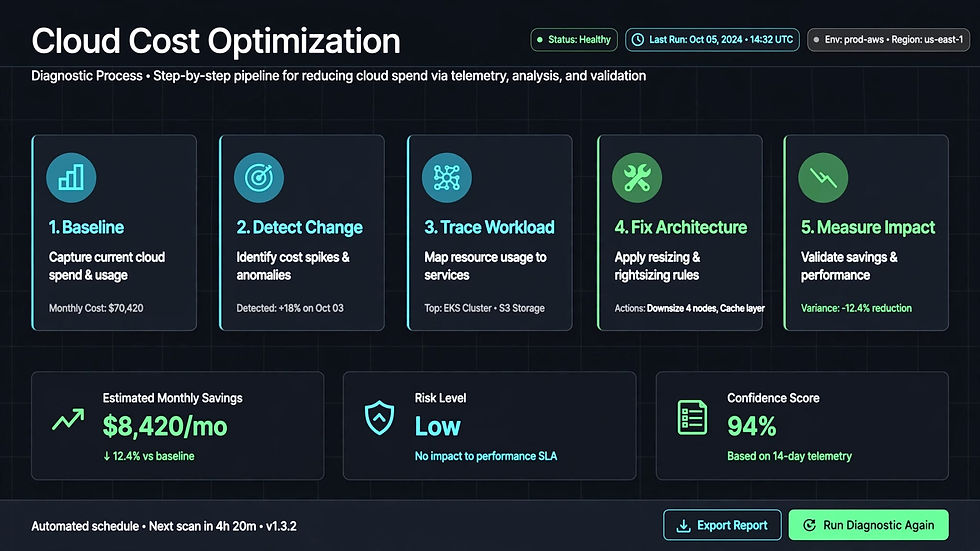
A Better Way to Diagnose Rising Cloud Costs
When cloud spending begins to grow faster than the product, the first step should be understanding the relationship between business activity and infrastructure consumption.
Start with a baseline
First determine what normal looks like.
How much does the platform cost to operate today?
How does that cost relate to customers, transactions, API requests, data volume, or another meaningful business metric?
Without a baseline, it is difficult to determine whether an increase is actually abnormal.
Find what changed
Next, look for the point where the cost behavior changed.
Did infrastructure usage increase gradually with customer growth?
Or was there a sudden change after a deployment, architecture change, new feature, data migration, or traffic event?
The timing can provide an important clue.
Identify the workload behind the cost
Once the major cost driver is known, investigate what workload is generating it.
Instead of stopping at:
“The database is expensive.”
Ask:
“What is the database doing that changed its resource consumption?”
Instead of:
“Network costs increased.”
Ask:
“Which communication patterns or data transfers increased?”
Instead of:
“Compute usage is high.”
Ask:
“Which workloads are consuming the additional capacity, and why?”
This moves the investigation from billing to engineering.
Fix the behavior, not only the resource
Rightsizing a resource can reduce spending.
But if the underlying application behavior remains inefficient, the same problem may return as the product grows.
A durable optimization therefore addresses the cause whenever possible.
Measure the result
After making a change, compare the new resource behavior with the original baseline.
Did the workload become more efficient?
Did performance remain acceptable?
Did the cost per transaction improve?
Did the optimization continue to work as usage increased?
Cloud optimization should be measurable because otherwise it is difficult to distinguish a real improvement from a temporary reduction.
When Cost Optimization Becomes an Architecture Problem
There is a difference between optimization and architectural correction.
Removing unused resources, adjusting capacity, and selecting better pricing models can be valuable.
But those changes have limits.
If an application repeatedly performs unnecessary work, moves excessive amounts of data, uses inefficient queries, or has architectural components that do not scale well, the solution may require changes to the software itself.
This is where cloud cost management becomes an architecture problem.
The question is no longer:
“How can we make this month's bill smaller?”
It becomes:
“How should the system be designed so that growth remains economically sustainable?”
That may involve refactoring a service, redesigning a data access pattern, changing how workloads communicate, improving asynchronous processing, revisiting scaling behavior, or modernizing part of the architecture through custom software development.
The right answer depends on the system.
There is no universal architecture that produces the lowest cost for every application.
Cost always has to be considered alongside reliability, security, performance, maintainability, and business requirements.
Build for Cost Efficiency Before You Need It
Cloud cost optimization should not be a one-time project that happens after a large bill arrives.
It should become part of the way the engineering team evaluates the system over time.
AWS recommends regularly reviewing workloads because architectural decisions that were once appropriate may become less cost-effective as requirements and services change.
The same principle applies regardless of whether the application runs on AWS, Google Cloud, or another platform.
As the product evolves, ask:
Is the architecture still appropriate for the way the system is being used today?
That question is broader than cost.
It also addresses scalability, reliability, performance, and maintainability.
And it can prevent a common situation where an application is successful from a product perspective but increasingly difficult to operate economically.
The Goal Is Not the Lowest Cloud Bill
The cheapest infrastructure is not necessarily the best infrastructure.
Reducing capacity too aggressively can create performance or reliability problems. Moving workloads simply because another service appears cheaper can introduce operational complexity. Rewriting a stable system purely to reduce a relatively small expense can cost more in engineering time than it saves.
The objective is different.
The goal is to build an architecture where infrastructure spending makes sense relative to the value the system provides.
When the product grows, infrastructure costs should grow for understandable reasons.
When costs grow faster than usage, the team should be able to investigate why.
And when the cause is architectural, the solution should address the architecture rather than treating the monthly bill as an isolated financial problem.
That is the difference between simply reducing cloud spending and building a cost-efficient system that can continue to scale.
Frequently Asked Questions
Why do cloud costs grow faster than a product?
Cloud costs can grow faster than users or revenue when infrastructure usage becomes less efficient as the system scales. Inefficient queries, excessive data processing, network traffic, logging, overprovisioned resources, or poorly configured scaling can all increase spending faster than business activity.
Is cloud cost optimization mainly a finance problem?
No. Finance teams can monitor budgets and spending, but many of the underlying causes of cloud cost growth are technical. Engineering and architecture teams need to understand how application behavior translates into infrastructure consumption.
Should I reduce cloud resources if my bill is too high?
Not automatically. Reducing resources without understanding the workload can create performance or reliability problems. The better approach is to identify why resources are being consumed and then determine whether the capacity, architecture, or application behavior should change.
Can AWS and GCP costs be optimized in the same way?
The specific services and pricing models differ, but the underlying principles are similar. Teams need visibility into usage, appropriate resource sizing, demand management, data transfer, workload efficiency, and ongoing architectural review.
When should a company conduct a cloud architecture review?
A review can be valuable when cloud costs begin growing faster than business activity, when infrastructure becomes difficult to understand, when performance problems appear during growth, or when the architecture has accumulated significant changes without a broader technical review.
Can cloud cost optimization create technical debt?
Yes. Short-term cost reductions can create technical debt if they involve workarounds, excessive complexity, or decisions that solve a billing problem without considering maintainability and future growth. Cost optimization should be evaluated alongside the long-term health of the system.
What should a CTO look at besides the monthly cloud bill?
A useful view connects infrastructure spending with meaningful business and technical metrics. Depending on the product, this can include cost per customer, transaction, API request, workload, or unit of data processed, along with application performance and resource utilization.
Final Thoughts
Cloud infrastructure gives growing companies flexibility, but that flexibility does not eliminate the need for architectural discipline.
As a product evolves, the assumptions behind its original architecture also need to evolve.
A system that was efficient at an early stage may behave very differently at scale. The goal is not to prevent infrastructure costs from increasing. The goal is to make sure those costs increase for the right reasons.
When cloud spending consistently grows faster than the product, the monthly bill is often only the visible symptom.
The more important question is what the architecture is doing underneath it.


Comments